
The Transit Priority Atlas maps and illustrates the strategies and tools cities have implemented to ensure faster and more reliable street-running transit. The Atlas includes visuals for each strategy and tool listed.
Italicized terms are defined with examples in the Glossary.
Strategies for Transit Priority
Targeted Strategies – Addressing transit delays in a specific location
- Reduce Delays from Curb Friction: Boarding and waiting to re-enter traffic creates friction that slows both traffic and transit
- Dedicated lanes and center-running lanes can insulate transit from curb friction
- Contraflow transit lanes are insulated from curb friction by design
- Reduce delays from transit stops: Boarding and waiting to re-enter into traffic are the two major causes of delay at transit stops
- Eliminate gaps from platform to vehicles to create level boarding
- Move bus-stops to the far-side of intersections rather than the near side to reduce delays from vehicles making right turns ahead of the bus in front of the stop
- “Bus bulbs” and “signal protected on street platforms” (Figure 1) can be added to make stops safer and quicker for boarding
- Signal or yield protected “transit gates” (Figure 2) can be used to help buses re-enter traffic at pinchpoints
- Physical obstacles to prevent overtaking (medians, etc.) can be used to improve pedestrian safety around bus stops
- Reduce delays at intersections: Transit delays at intersections can be mitigated by creating Priority Corridors For Transit
- Signalized intersections can be improved by using a transit queue jump (Figure 3 shows an intersection with queue jump lanes for buses) to reduce queue buildup and prohibiting left/right turns on two-direction streets
- Signal delay times can be reduced by implementing Transit Signal Priority (TSP) at intersections
- Roundabout delays can be improved through dedicated transit lanes and transit signals in roundabouts
- For simple intersections, giving priority to the main street where transit runs would minimize transit delays at intersections
- Provide a shortcut for transit: Delays can be caused from the nature of the road network itself (homes, schools, shops, and other popular destinations might be located away from main roads forcing buses into time-consuming lengthy, looping patterns to reach all the stops)
- Retrofitting/planning dedicated transit-only shortcuts can reduce the detours taken by transit that follows the regular road network
- Design for high capacity: On routes where transit operates many vehicles, transit can be its own source of delay if buses get stuck waiting behind other buses during boarding
- Have dedicated overtake lanes (especially when there are express buses and local buses running)
- “Skip-stop patterns, long continuous boarding platforms, or stops scattered around a major square” can prevent delays from buses queueing to pick up passengers from one terminal
- Dedicated turn lanes for transit at transit heavy intersections
- Although extremely space intensive, multi-lane corridors are the best way overall to increase transit capacity
Systemic Strategies – Coordinated measures that address transit priority at a system-wide traffic-management strategy
- Identify Priority Corridors for Transit: Systematically limit through-traffic on lateral streets (Figure 4 shows lateral streets arranged around main roads) and reshape the circulation patterns of local streets in the broader area to create corridors for transit. Tools used to develop and implement a transit corridor vary depending on the location
- Mixed traffic: Converging/diverging one way lateral streets, dead-ends
- Center-Running Transit Lanes: Treat intersections with lateral streets as right in/right out set-ups
- Edge Running Transit Lanes: Use unilateral dead-ending, or services roads/lanes to collect traffic from lateral streets
- Corridors with offset or curb-adjacent transit lanes: move lateral streets to converge in one way configurations
- Divert Through Traffic: Deploy strategically located priority tools to divert private through traffic away from a transit-priority through route
- Use short segments of transit streets, transit ways, contraflow transit lanes, and transit modal filters to implement and plan the diversions
- Reduce Background Traffic: Prioritizes transit, improves environment and quality of life
- Access regulations restrict usage of roads or vehicles to certain users or during certain parts of the day
- Congestion or Road pricing schemes, used in large metropolitan areas like New York City, reduce congestion and improve transit reliability through disincentivizing people to drive through heavy traffic areas
Toolbox for Transit Priorities
A glossary of terms from the Transit Priority Atlas.
Linear Continuous Measures – Otherwise known as “dedicated lanes”
Transit Priority Streets
- Transit Streets: Segments of urban streets that only allow transit vehicles (Ex. Denver, CO 16th Street Mall)
- Transit Ways: Segments of roads, generally independent from the rest of vehicular circulation, that are fully reserved for transit vehicles (Ex. Seattle, WA Third Avenue Transit Mall)
- Transit and Direct Access Streets: Urban streets where only transit is allowed to continue through at intersections (Ex. New York City, NY 14th Street Busway)
Center Running Transit Lanes
- Center Running Transit Lanes: Transit dedicated lanes located in the center of the roadway (Ex. Boston, MA – Columbus Avenue Bus Lanes)
- Center Running Transit Lanes on Freeway Medians: Transit-dedicated lanes located in the median of limited-access highways (Ex. Houston, TX Houston Managed HOV/Bus Lanes)
- Static Alternate-Direction Center Running Transit Lanes: A single central transit lane changes direction mid-block and at intersections (Ex. Northern France)
- Dynamic Alternate-Direction Center Running Transit Lanes: single dedicated transit lane in the center of the roadway in both directions (Ex. Indianapolis, IN N College Avenue)
Edge Running Bidirectional Transit Lanes: configuration in which both directions are located on one edge of the roadway (Ex. New York City, NY Fulton Street Mall)
Off-set Transit Lanes (Parking Adjacent): transit-dedicated lanes located in the rightmost driving lane, next to curbside parking (NYC – Lexington Avenue)
Curbside Transit Lanes
- Curb-adjacent Transit Lanes (Ex. Washington DC Georgia Avenue NW)
- Transit Lanes on Freeway Shoulders (Minneapolis – St. Paul Metropolitan Area)
Contraflow Transit Lanes and Offset Contraflow Transit Lanes: unidirectional transit lanes that go against the main direction of general traffic on one-way streets (Ex. Eugene, OR 11th Avenue)
Queue Jumps
- Offset Queue Jumps Lanes and Curbside Queue Jump Lanes: short segments of transit-dedicated lanes that allow transit vehicles to bypass upstream queues at signalized intersections (Ex. Chicago, IL 79th Street)
- Virtual Queue Jump Lanes: deploy pre-signals (i.e., signals localized upstream of the intersection) to allow transit vehicles to use a general traffic lane, including opposite-direction ones, as a temporary “virtual” queue-jumper after it’s cleared by all other traffic (Ex. Washington DC Georgia Avenue)
Localized Measures – Typically targets points of delay
Signal-Controlled and Yield Control Bus Gates: traffic management devices that give priority to transit vehicles over other vehicular traffic at specific locations (Ex. Boston, MA Brighton Avenue)
Turn Conflicts Managments
- Indirect Left Turn via Alternate Itinerary: Banning left turns by making an alternate right-turns based route (Ex. Detroit, MI – Hall Road)
- Right in/Right Out: suppresses all left turns from and into lateral streets, as well as through movements between lateral streets (Ex. Colorado Freedom Parkway)
- Dead Ending of Lateral Streets (Ex. Almere, Netherlands Map and Information)
Bus Stop Related
- Bus Bulbs: Bus bulbs extend boarding platforms into the parking lane to allow buses to load passengers without pulling out of the main traffic flow (Ex. DC – 8th St and H St NE)
- Signal Protected on Street Programs: driving lane across the stop is raised to the sidewalk level and doubles as a boarding platform
Transit Modal Filter: Localized devices that allow transit to proceed through a given pinchpoint while preventing general traffic from doing so (Ex. Madison, WI Mendota Street)
Bologna Case Study – Bologna implemented transit-priority policies between the 1970s and 2000s in a comprehensive and incremental effort to preserve the viability and usage of bus transit. The measures taken, including strategies and tools described in the Transit Priority Atlas, were relatively low cost, within the local government’s jurisdiction, and have positioned Bologna to be a compelling case for the consistent application of circulation-planning principles and transit priority features in cities around the world.
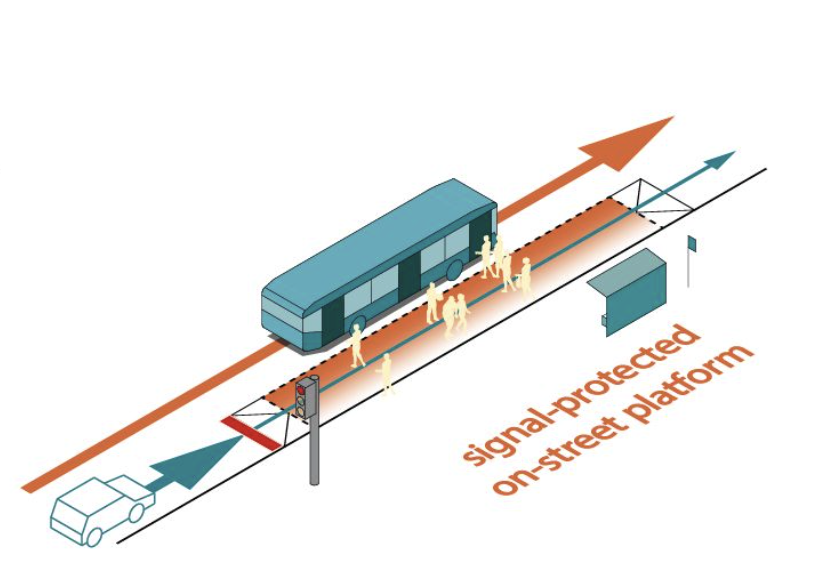
Figure 1
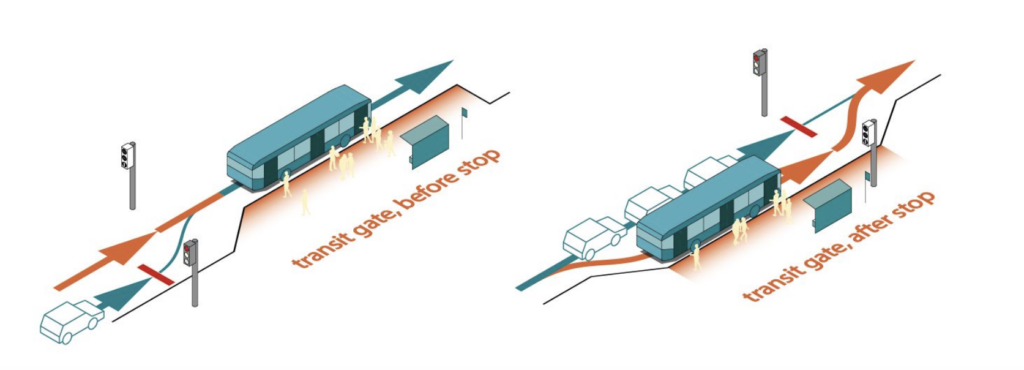
Figure 2
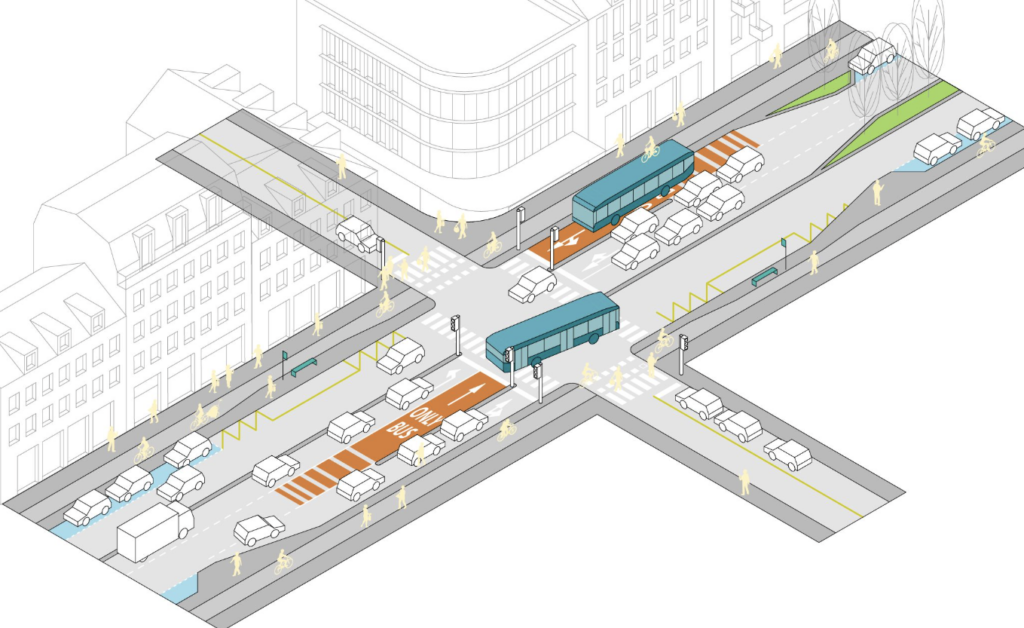
Figure 3
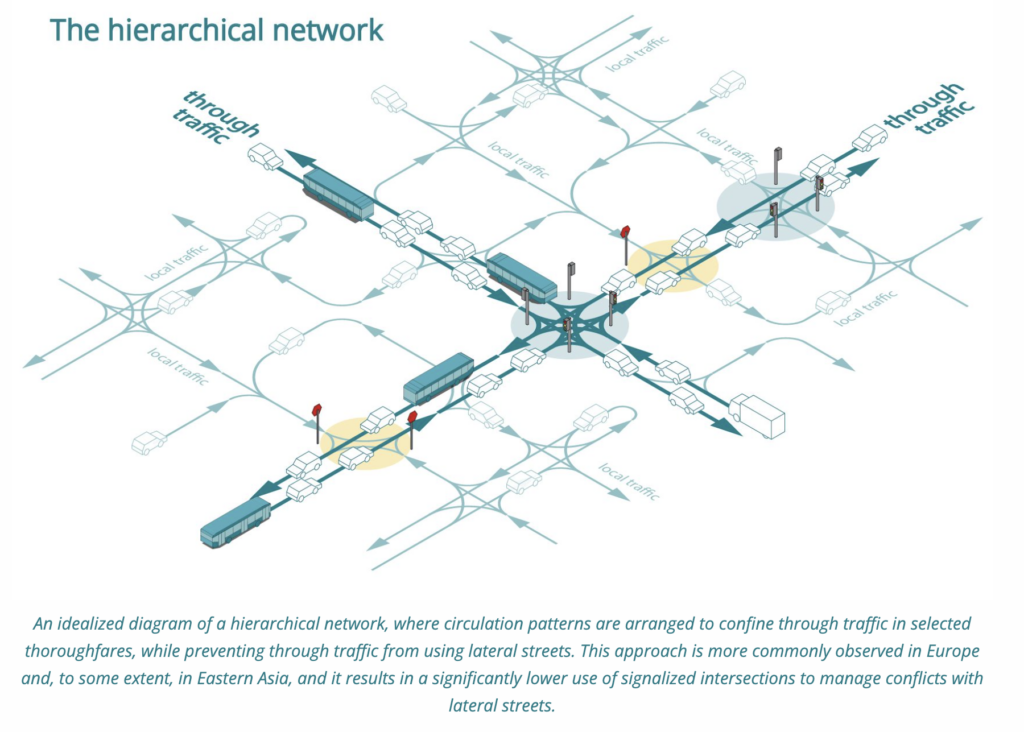
Figure 4