
Uplifting transit issues in your local and state elections is an important part of building a winning transit strategy, but 501(c)(3) organizations face limits on how much electoral work they can do without risking their tax status.
A 501(c)(4) empowers an organization to do unlimited lobbying and to advance its issues through electoral campaigns; however, it’s important to understand that more than 50% of the organizations’ work must be advancing issues campaigns – this is often referred to as the “Primary Purpose Rule.”
501(c)(3) vs 501(c)(4)
The Alliance for Justice shares examples of independent election activities that 501(c)(4) organizations can engage in, that expand beyond work a 501(c)(3) can do :
- “Conducting all of the nonpartisan voter education activities in which 501(c)(3)s can engage;
- Supporting or opposing ballot measures;
- Endorsing federal, state, and local candidates;
- Distributing communications to the general public — including through GOTV activities, voter registration drives, billboards, broadcast ads — or to the organization’s membership in support or opposition to federal or state candidates.
- The organization can even encourage voters to vote for or against a specific federal or state candidate.
- Asking federal and state candidates to pledge to support the organization’s issues if elected.
- Producing candidate voter guides or comparisons of where state and federal candidates stand on the issues;
- Creating an affiliated 527 political organization called a “connected PAC” or “separate segregated fund” to make contributions to federal candidates;
- additionally, many states allow 501(c)(4) organizations to create connected state PACs;
- and Pooling resources to engage in the above activities, subject to federal and/or state disclosure rules and limits.”
- Quick Guide: Alliance for Justice Election Year Activities for 501(c)(4) organizations
- C3/C4 Chart Comparing Allowable Activities
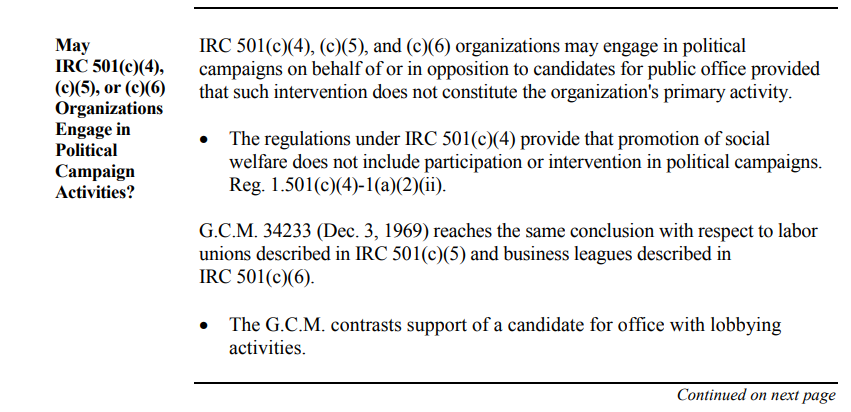
It is important to remember that working on and spending on elections can not be the primary role of the 501(c)(4) organization. According to the IRS, “a section 501(c)(4) social welfare organization may engage in some political activities, so long as that is not its primary activity. However, any expenditure it makes for political activities may be subject to tax under section 527(f). For further information regarding political and lobbying activities of section 501(c) organizations, see election year issues, political campaign and lobbying activities of IRC 501(c)(4), (c)(5), and (c)(6) organizations.”
What is a 501(c)(4) organization?
IRS Definition: To be tax-exempt as a social welfare organization described in Internal Revenue Code (IRC) section 501(c)(4), an organization must not be organized for profit and must be operated exclusively to promote social welfare.The earnings of a section 501(c)(4) organization may not inure to the benefit of any private shareholder or individual. If the organization engages in an excess benefit transaction with a person having substantial influence over the organization, an excise tax may be imposed on the person and any managers agreeing to the transaction.
What is excess benefit?
Read the IRS memo: IRC 501 C4 Organizations.
A 501(c)(4) organization must “be operated exclusively to promote social welfare, an organization must operate primarily to further the common good and general welfare of the people of the community (such as by bringing about civic betterment and social improvements).
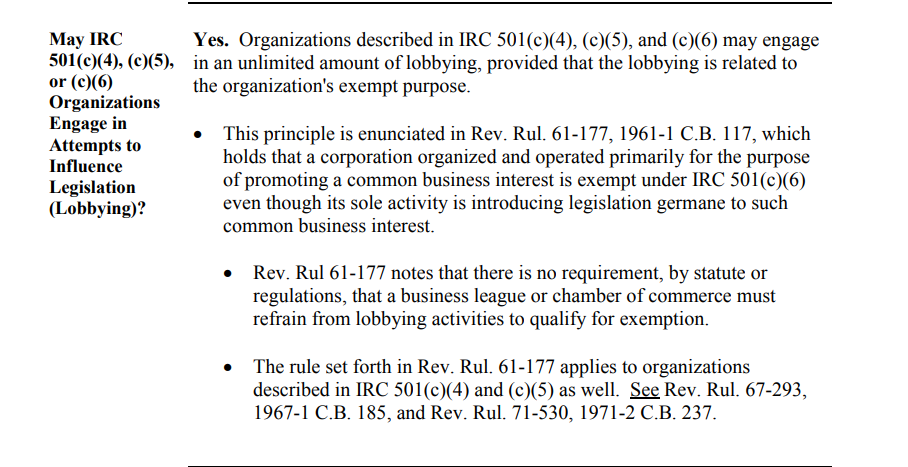
Can a 501(c)(4) organization lobby to advance legislation?
Seeking legislation germane to the organization’s programs is a permissible means of attaining social welfare purposes. Thus, a section 501(c)(4) social welfare organization may further its exempt purposes through lobbying as its primary activity without jeopardizing its exempt status.”
The promotion of social welfare does not include direct or indirect participation or intervention in political campaigns on behalf of or in opposition to any candidate for public office. However, a section 501(c)(4) social welfare organization may engage in some political activities, so long as that is not its primary activity. However, any expenditure it makes for political activities may be subject to tax under section 527(f). For further information regarding political and lobbying activities of section 501(c) organizations, see election year issues PDF, political campaign and lobbying activities of IRC 501(c)(4), (c)(5), and (c)(6) organizations PDF, and Revenue Ruling 2004-6.
https://www.irs.gov/pub/irs-tege/eotopicl03.pdf
In Summary:
The purpose of a 501(c)(4) organization is to promote social welfare for the public good, not for profit.
Purpose and activities
-
- Promote social welfare: The organization must operate exclusively to further the common good and general welfare of the community.
- Engage in political activity: A 501(c)(4) can spend money to support or oppose candidates for political office and can also lobby.
- Maintain a primary focus: Political activity cannot be the organization’s primary purpose; no more than half of its activities should be political.
- Filing Form 8976 is the first step in setting up a 501 c) (4)
Establishing a 501(c)(4) Organization
Steps to take to become a 501(c)(4)
-
- You will need the following information to begin to fill for a
- An email address to activate your login ID and password
- Business name
- Address
- Employer Identification Number or EIN: link to form
- Date organized
- State and country organized
- Filing year/month: This is the specific 12-month accounting period for which an individual or business is reporting their income and expenses for tax purposes. For example: Jan 1 to Dec 31
- Statement of purpose of the organization
- Have filed Articles of Incorporation with you state (see below)
- You will need the following information to begin to fill for a
- Must notify the IRS of your intent to become a 501(c)(4) by filing Form 8976, Notice of Intent to Operate Under Section 501(c)(4). There is a $50 filing fee, so you will need a credit card to pay online at Pay.gov. Register and fill out the Form 8976, by starting here: Electronic Notice Registration System
- After Form 8976 is submitted, the IRS should notify you and acknowledge that they have received your form within 60 days. In addition, if the form is not filled out correctly, they will let you know.
- For technical assistance or questions about the form, call TE/GE Customer Accounts Services at 877-829-5500.
How to submit Form 8976
To electronically submit Form 8976, Notice of Intent to Operate Under Section 501(c)(4), use the Form 8976, Electronic Notice Registration System.
You do not need special software to submit a notification. You do need an email address to activate your login ID and password.
Additional information and resources
- Form 8976, Notice of Intent to Operate Under Section 501(c)(4) FAQs
- CPEO/501(c)(4) system access/assistive technology FAQs
- Regulations and proposed rule
- Revenue Procedure 2016-4 (issued July 8, 2016)
- Educational tools – Online learning to help tax-exempt organizations stay exempt
- EO Update – Subscribe to the IRS Exempt Organizations email newsletter that highlights new information
- Alliance for Justice, “The Practical Implications of having a 501 c3 and 501 c4”
- National Committee for Responsible Philanthropy “8 Common Sources of Funding for C4 Nonprofits”
- Sample working agreement between a tandem 501 c) (3) and 501 c) (4): Alliance for Justice model agreement
Articles of Incorporation
The National Council of Nonprofits explains, “There is also a DIY option. Determine which state agency, generally the Secretary of State of your state, regulates the formation of corporations, and look for published guidance on the state’s website for starting a nonprofit corporation. In some states, the terminology is “non-stock” or “not-for-profit” corporation.
Below are the basic steps. Regulations differ greatly from state to state, so this listing should not be considered comprehensive and is not a substitute for professional guidance.
- Reserve/register the intended name of the nonprofit corporation to make sure that no one else has created a nonprofit of the same name.
- File Articles of Incorporation (called a “certificate of incorporation” in some states.) Some states require supplemental information, such as:
- Certificate of Disclosure
- Designation of an agent (usually requires a physical address)
- Proof of Corporate Name
- Filing fees – be sure to follow the instructions on the forms and pay all applicable filing fees.
- Extra steps, depending on state:
- In many states you must publish the articles of incorporation a certain number of times in a local newspaper, then file proof of publication with a state agency.
- Samples to consider:
- Prepare and adopt bylaws
- Prepare and adopt a conflicts of interest policy
- Prepare and adopt compensation policies
- What are Articles of Incorporation, and common questions
- Sample Articles of Incorporation
Transit as an Issue in Elections
Transit is a winning issue; in 2024, APTA reported 51 wins out of 61 measures for public transit, an 86.7% win rate.“The public’s enthusiasm for investing in transit reflects a clear desire for cleaner, more accessible transportation options in their neighborhoods. The 2024 election has marked a significant step forward for public transportation, as communities continue to invest in a brighter, more sustainable future for everyone.” – CEO Paul P. Skoutelas.
APTA’s national voter survey, which reinforced this showed that:
- 81 percent of Donald Trump voters oppose any cuts to current levels of public transportation investment;
- 69 percent of all voters support the use of their tax dollars for public transportation. This includes a majority (53 percent) of Trump voters.
- More than 69 percent of Americans believe our public transportation infrastructure is in “crisis,” including 63 percent of Trump voters.”
“Voters Overwhelmingly Support Transit Nationally This Election Cycle”